
Dissecting: Looking Backwards, by Edward Bellamy - Preview
Setting the Stage

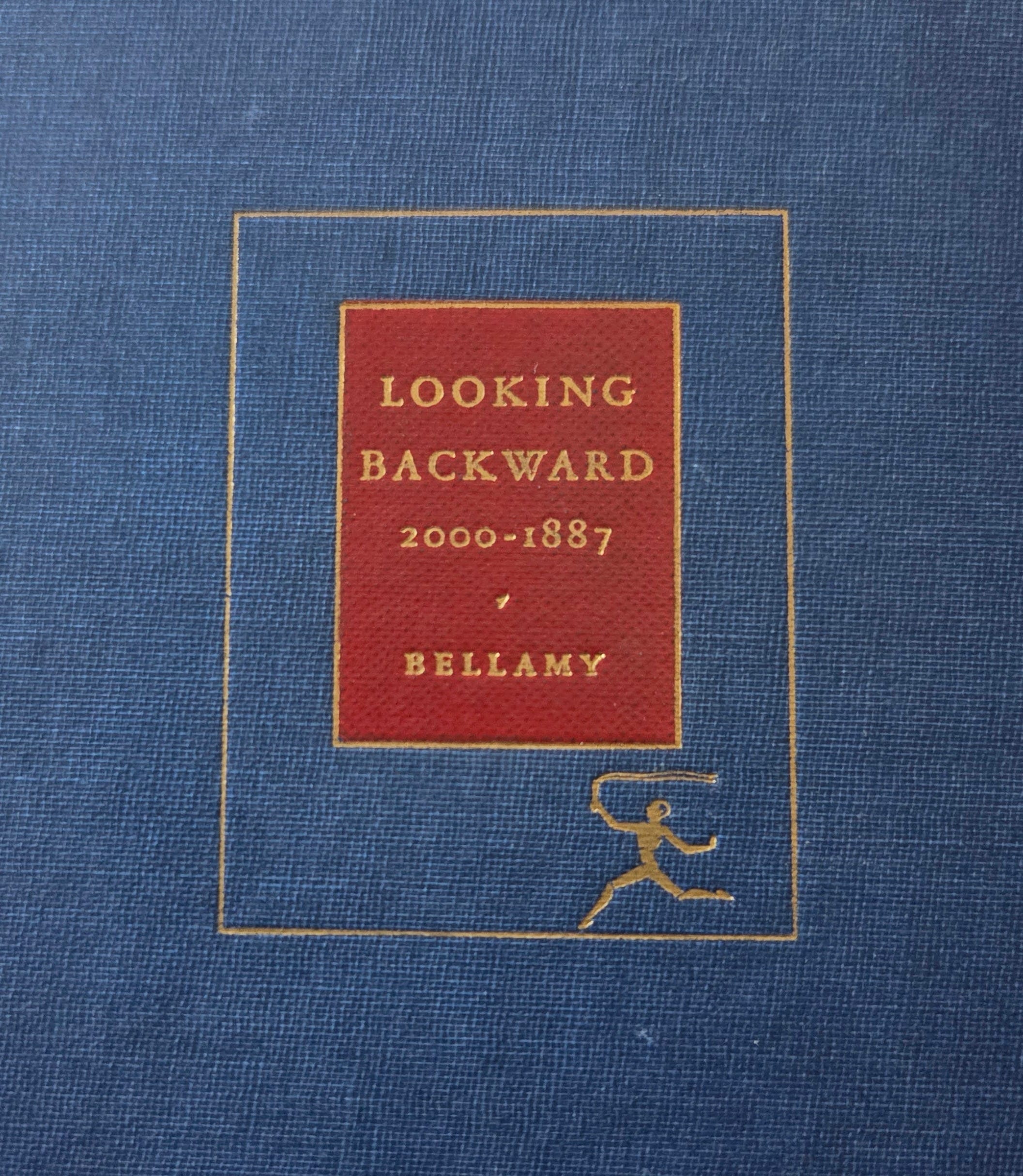
Every now and then we accidentally come across a book, not knowing how much of an impact it will make on us. One of the first times this happened for me was when I read the book One, Two, Three, Infinity by George Gamow in eighth grade off my Dad’s bookshelf, then when I randomly bought in the mall, and read, Hyperspace by Michio Kaku in tenth grade, which is what got me back into reading in my spare time.
The book I am reading now appears to be another of those gems which, having randomly found its way to me, is striking a particular type of thoughtful interest in me which I would not have expected it to evoke at the time when I found it. So I have to thank past me for my bibliophile tendencies, that simply finding this book interesting looking, and acquiring it no more assumingly, was enough to lead to the experience I am having now while reading it.
I found this book while browsing a free book shelf in the corner of our philosophy department at the college I went to. I enjoyed periodically stopping at looking at that shelf just to imagine what all the book might conceal, but I rarely took anything. I guess, given the context, I could have expected this book to be a sort of philosophy book, but I expected it to just be an interesting old speculative fiction book. In some way, it is, but it is also so much more, which is why I am finding it so interesting.
So, let’s start setting the stage: this book is Edward Bellamy’s Looking Backward. It was written in 1887 and imagines a Boston man, Julian West, waking up from a sort of coma to find that it is now a utopian year 2000. So, more than just being a speculative fiction book, this book does what many great philosophical works do and uses a hypothetical situation to investigate or lay out a certain framework of thinking.
The book gives us an interesting look into what a person at the end of the 19th century who is educated in political philosophy might have thought about the trajectory of society at the time, and in expressing this to us, it gives us some very interesting diagnoses of society which are still considerable today. Even in the book’s preface (which we will be largely staying in for today’s piece), written by a professor of English from the 1950s, Robert L. Shurter, it is admitted that many aspects of the utopian view which Bellamy suggests seem to be projections fitting more to be many centuries out, than just over one-hundred years.
However, it is also noted that at the turn of the twentieth century, this book was read by many young people in hopes of what the future may hold, and as a diagnosis of society. So, in many ways, this book likely helped shape the thinking of people and changes going into the start of the 1900s in America. Sometimes the best activism is a book that gives people hope that there is a different way things could be.
In the book’s introduction, Shurter gives us some context into what the world was like at the time the book was written, and then at the time when it was received. It is noted that American industry had changed pretty significantly between the 1850s and the 1880s, with a trend towards mass industrialization and production-line factories. Small business was giving way to monopolized corporatocracy. Workers were being further exploited by the tightening of business and the conditions of being a small piece of a big production line that funnels most of its profits and good/amenable conditions to the few.
By the middle of the 1880s the fight for better working conditions was being more publicly vocalized. Shurter notes the labor struggles of 1886 and the Haymaker Riot, then Carnegie Steel strikes which happened after the book’s release (1). Bellamy himself starts the book with an extended metaphor that serves to denote the contrast of what it is like to live off of generational wealth versus trying to build a business/opportunity from scratch next to a forming monopoly, or the consolidation of business power.
This book was born from the time of the fight for the eight hour work day, and apprehension towards the furthering separation of the employer and the employed. The discussion it gives rise to, while choosing to call itself a form of nationalism, really shows an interesting lens into the contrasts of socialism and capitalism. The idea of nationalism that we have today likely did not exist back then, and so one needs to consider the context of creating one’s own usage of a word, when seeing Bellamy’s influence on the turn of the century nationalism of his time.
Bellamy’s idea of nationalism, as we will come to see when we start dissecting the actual book, is not so much tied to the modern global political dipole of nationalism versus globalism (in which some politicians reserve a vested interest to convince us that globalism is evil), but more closely to the cultural dynamics of collectivism versus individualism. It calls itself nationalism because it wonders what would happen if the nation itself took over much of the aspects of business monopolization which if left unchecked lead to corrupt incentives. It wonders if a form of the nationalization of business could solve the problems with business corruption towards wealth and wellbeing division. Already, one may see some interesting adages popping up in the foreground of the discussion, things like the idea that ‘we have to go through capitalism to get to a proper form of socialism.’
A quote from the book reads,
“…strangely late in the world’s history, the obvious fact was perceived that no business is so essentially the public business as the industry and commerce on which the people’s livelihoods depends, and that to entrust it to private persons to be managed for private profit is a folly similar in kind, though vastly greater in magnitude, to that of surrendering the functions of political government to kings and nobles to be conducted for their personal glorification.” (42)
One may see in this how some of the discussion will be pertinent to problems of corruption (and business consolidation) that it seems we are still finding our way out of, which is why I think it could be interesting to dissect the discussion of this book as I finish reading it. As I noted, the book employs common philosophical methods of discussion wrapped into a dialogue, and perhaps that is what made it so digestible to the masses at the time.
Those practiced in philosophy should be familiar with various works who walk us through a philosophical discussion by using certain characters to pit certain ideas against each other, like that of Berkeley’s discussion between Hylas and Philonous, or old discussions imagined between Plato and Aristotle or Socrates. The Socratic Method, after all, was the name given to this type of philosophical discussion building through character dialogue and expanding text-context discussions.
One of the reasons this book interests me to dissect is that the way it is talked about, it is made sound like every American would have known about this book at the turn of the 1900s, but I don’t know if anyone I know would have heard of this book. We will see, of course, that not every prediction this book makes will have merit, but it provides a unique view into the thought of the time. A time before cars, before even lightbulbs were common. Some of the predictions and apprehensions of the book haven’t panned out as expected, while others have been already solved, and others remain to be fully addressed in society. But, in our current time of further widening wage gaps and living conditions, and the running amuck of corrupt business incentives, much of the discussion I think feels like a breath of fresh air: to know that even back in these times people could express so eloquently the pitfalls of some of the societal dynamics we are still working to ascend.
Perhaps the reason it feels so refreshing to read this perspective, coming from this time, is precisely because of how good our current times have become at wearing us down. In this book, there is no doomscroll to steal our attention, to keep us complicit, and yet it calls out many of the paradigms which have over time led us to be trapped in this dynamic. It seems to offer a clear view diagnosis of society, and structural greed, while admittedly portraying an outdated prediction framework in other ways.
We will continue in the next installment by dissecting the first few chapters of the actual book, its predictions, and its grievances with the way things are.
Notes:
(1) The labor struggles of 1886 saw workers across the country go on strike on May 1st, in the fight for the eight-hour workday. The Haymaker Riot, which happened on May 4th in Chicago (a hub for much of the discussion around the labor movement of the time), culminated in an unfortunate incident where, as police tried to dispel public unrest in the streets, someone threw a stick of dynamite at them, and they fired back at the crowd. The casualties were seven police, four civilians, and multiple injured.
At the Carnegie Steel Strike in 1892, also known as the Homestead Strike, union workers fighting for better wages and working conditions were just locked out of work and replaced by non-union workers who would do the work for cheaper and worse conditions. These fired workers came back to strike the now fortified workplace and were attacked by agents hired to disperse them, and a shootout ensued. The way it went made the strikers look bad for firing first and for trapping the ships of the agents (the Pinkertons). While the strikers could be said to have won that battle and tensions starting to settle, Governor Pattison decided to put the town under martial law, needing the support of the Carnegie business. Workers were forced to make way for non-union workers, which led to a race war, and again the boss Frick refused to budge on working conditions. A week later a proclaimed ‘anarchist’ came to town from New York and shot and stabbed Frick, who lived, and it made the union workers look even worse. So, in general, the developments of the Homestead Stike were seen as a massive setback towards union efforts to progress the providing of amenable workplace conditions. (my sources are Wikipedia, sorry)